
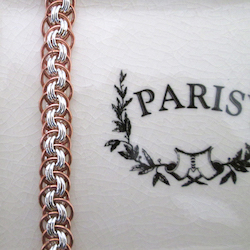
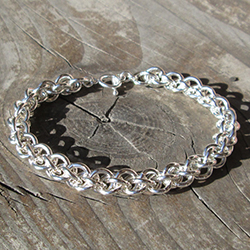
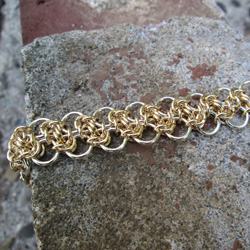
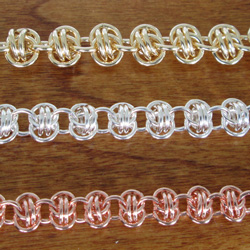
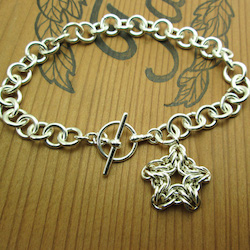
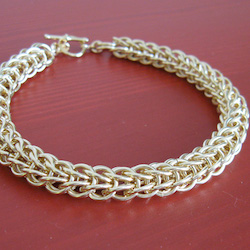
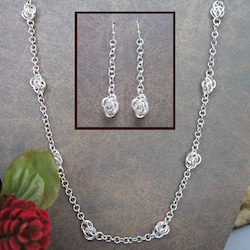
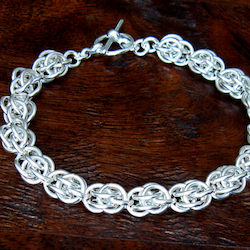
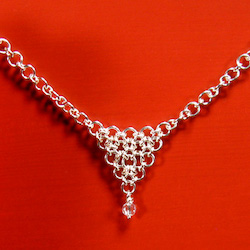
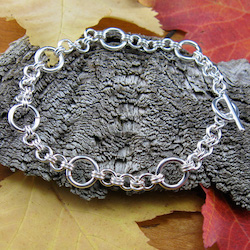
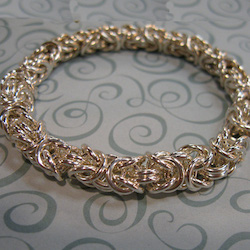
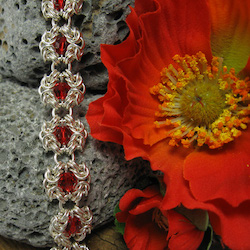
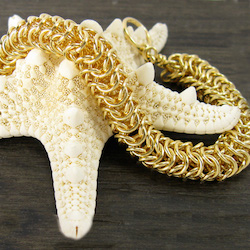
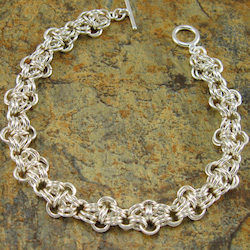
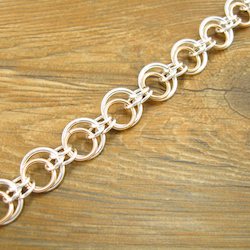
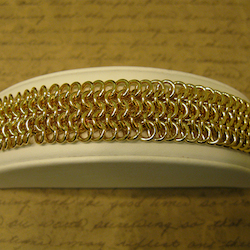
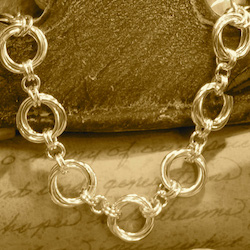
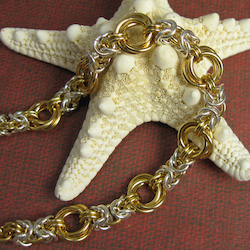
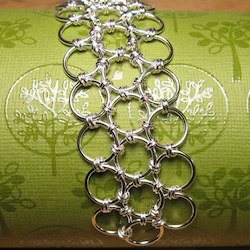
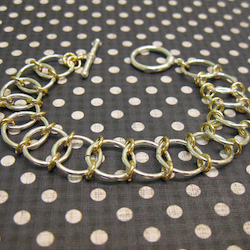
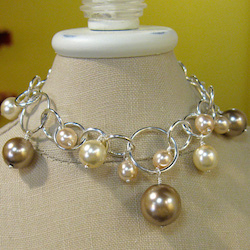
Our most popluar chain with lots of variations. In this example we have created a heavy weave using 16ga 4.5mm ID Jump Rings. Kits available in Sterling Silver, Silver-Filled, Silver Plate, 14kt Gold Fill, Copper and Brass.
Instructions Kit Available

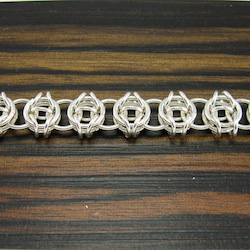
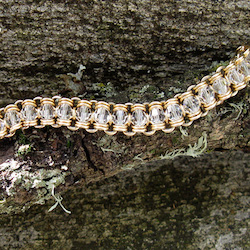
This original design developed by the Bead Man, was inspired by the classic tennis bracelet. This example uses 18ga 3.5mm ID and 18ga 3.0mm ID Jump Rings. The crystals are 6mm Round Faceted beads, but any 6mm round bead will work.
Instructions Kit Available

The Japanese six-in-one chain or Flower Chain is one of the most traditional flat maille patterns. We have doubled up on the small rings for texture.
Instructions

A festive holiday earring using your best chain making techniques. The secret is the Open Round Chain Maille that makes up the tree's trunk.
Instructions Kit Available

An Advanced chain for those that want a little more challenge. Based on the Bubble Chain the Double Bubble is a 6-in-1 variation. In this 7" Bracelet example we are using (14)14ga 6.0mm I.D. for the large rings and (42)18ga 3.0mm ID for the medium and (220) 20ga 2.5mm ID for the small connector rings.
Instructions

The open round chain maille is a classic weave that every avid chain maker should master. It is the gateway to the closed round and turkish round chain patterns.
Instructions

A very versatile project, change the look by changing the jump ring sizes. An excellent beginner project.
Instructions Kit Available

This original design developed by the Bead Man, was inspired by the classic tennis bracelet.Our original Channel Bracelet is a single row, but the triple channel demonstrates that it is scalable. Make a wide bracelet, choker or belt.
Instructions

Our most popluar chain with lots of variations. In this example we have created a heavy weave using 16ga 4.5mm ID Jump Rings. Kits available in Sterling Silver, Silver-Filled, Silver Plate, 14kt Gold Fill, Copper and Brass.
Instructions

Florets are a great chain technique that can be incorporated into your jewelry and chain making project. Most ring sizes work, so make them big or make them small.
Instructions Kit Available

A great introduction to jump ring jewelry. Create an elegant platform to show off your favorite beads.
Instructions Kit Available

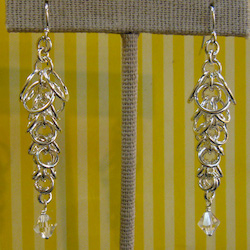
Dangely, Shiny and Fun! What more do you need in a pair of drop earrings, add you favorite crystal, stone or glass bead.
Instructions Kit Available

Resin Photo Jewelry make a beautiful, permanent keepsake. Follow the step-by-step instructions to learn how to create professional resin jewelry.
Instructions Kit Available

A great beginner chain for those that want a little more challenge. In this example we are using 14ga x.xmm I.D. for the large rings and 18ga x.xmm ID for the medium and 20ga 2.5mm ID for the small connector rings. The Bubble chain is the basic chain used for the more advanced Double Bubble.
Instructions

A really fun project that you can share with your kids. Easy to create, challenge yourself by using the smallest of seed beads and fine gauge wire. Try the free pattern, buy the book!
Instructions Kit Available
![]()
Unsure about which ring size to order? Download
our Ring Sizing Chart
for best sizing estimate.
Print out the .pdf for the most accurate sizing

I get frequent emails from customers looking to make a chain from our site using jump rings larger or smaller than those in the instructions. Aspect Ratio is the Ratio (value) between a jump rings wire thickness or gauge (GA) and its Inside Diameter (I.D). Aspect Ratio is sometimes shared by chain maille artists. They take their favorite chain and attempt to make it in different I.D. jump ring sizes until they get, what they consider the perfect chain. Instead of stating that the chain works in 16ga 4.5, they notate the A.R. allowing for the chain to be constructed using different size jump rings. This allows the next artist to build a lighter version using thinner gauge jump rings or a bolder version using thicker gauge jump rings and still maintain the structure of the chain.
The most popular request for aspect ratio is the Byzantine Chain (A.R. 3.5). Here is a quick chart for alternative sizes in jump rings. For those who have a thirst for knowledge, continue down to calculating Aspect Ratio.
22ga (0.6mm) x AR (3.5) = ID 2.1 (22ga 2.0mm ID)
20ga (0.8mm) x AR (3.5) = ID 2.8 (20ga 3.0mm ID)
18ga (1.0mm) x AR (3.5) = ID 3.5 (18ga 3.5mm ID)
16ga (1.3mm) x AR (3.5) = ID 4.5 (16ga 4.5mm ID)
14ga (1.6mm) x AR (3.5) = ID 5.6 (14ga 5.5mm ID)
1. We cannot calculate AR using gauge, especially since there is no one wire measurement standard. We use the A.W.G. American Wire Gauge. Be sure to pay attention between A.W.G and British S.W.G as the values are different.
2. Convert your favorite wire gauge into decimal millimeters. Tons of charts out there, click here is a link to one of wikipedia - AWG SWG
3. When you multiply your favorite wire thickness (converted to mm) with the Aspect Ratio, you will get your target Inside Diameter. NOTE: Just because you get 3.8746752 mm ID, don't get bent when we don't have that size. There is some leeway, generally I round up to the nearest half millimeter and try a 4.0mm ID. But I am just as willing to try 3.5mm ID if I think the results will give me a superior outcome.
Example: If your like standard byzantine, but you want a thicker ring like 16ga. You look up 16ga in the AWG chart which equals 1.291mm in thickness. The Aspect Ratio for Byzantine is 3.5. Multiply (gauge)1.291 mm X (A.R.)3.5 = 4.5185 mm I.D. I round down to 4.5mm ID.
Note: That byzantine has an A.R. of 3.2 minimal to 3.5 standard.